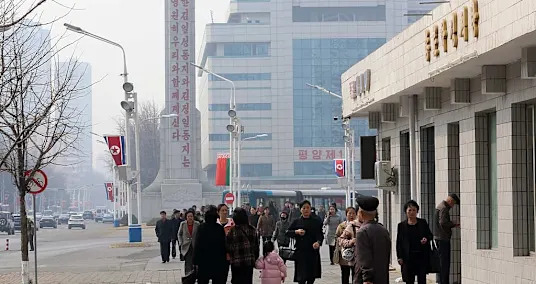
China has announced that its flag carrier, Air China, will resume direct flights to North Korea after a six-year pause, following the restoration of passenger train services between Beijing and Pyongyang.
This marks a significant step toward reopening North Korea, one of the world's most isolated nations, to the world.
Transport links between the two capitals had been suspended since the start of the Covid-19 pandemic in 2020, when Pyongyang implemented a very strict border closure.
While North Korean carrier Air Koryo already resumed flights to Beijing in 2023 and allowed Russian tour groups to visit in 2024, the return of China's air and railways are seen as a major economic milestone, as China has for decades been the main trading partner and a key source of diplomatic and economic backing for the country of 26 million people.
Before the pandemic, there were an estimated 300,000 foreign visitors in 2019, according to South Korea's Institute for International Economic Policy, and Chinese visitors accounted for 90% of all tourists to North Korea. Therefore, the long delay in resuming regular travel had surprised many regional observers.
"The reopening of these borders has been driven primarily by Pyongyang's timeline, which challenges the outdated assumption that Beijing dictates terms to a dependent client state," Seong-Hyon Lee, a visiting scholar at the Harvard University Asia Centre, explains.
Related
Nuclear ambitions complicated the relationship
Despite being Pyongyang’s primary ally, Beijing has frequently voiced disapproval over the North's persistent missile tests and nuclear ambitions. This aspect created a bumpy relationship with Pyongyang, with analysts saying that a nuclear-armed North Korea has often been something of a liability.
The diplomatic normalisation was highlighted last September, when Kim Jong Un attended a massive military parade in Beijing alongside Russian President Vladimir Putin. This was Kim's first appearance at a Chinese military display.
Lim Eul-chul, a North Korea expert at South Korea's Kyungnam University, argues that the war in Iran, in particular, increased "the need for closer coordination between the two nations".
LATEST POSTS
- 1
 Eight wounded, cars catch fire in central Israel following strike from Iranian cluster munition
 - 2Munich Security Conference chief defends inviting AfD lawmakers
- 3Reports: Germany plans expansion of foreign intelligence powers
- 410 Picturesque Campgrounds That Will Raise Your Outside Involvement with American
- 5An Extended time of Careful Nurturing: Individual Bits of knowledge on Bringing up Youngsters



- ‘The White Lotus’ sparked online interest in risky anxiety pills, study says
- IDF begins destroying homes used by Hezbollah as forces move deeper into southern Lebanon
- My skin feels drier, my lips thinner and my makeup heavier. How do I adjust my routine for aging skin?
- Eurovision Song Contest changes voting rules after controversial allegations against Israel
- I visited the largest collection of public telescopes in the US in Oregon's high desert, and the dark skies blew me away
- Watch live as near-Earth asteroid Eros buzzes the Andromeda Galaxy on Nov. 30 (video)
- Finding China: Four Urban areas for a Remarkable Excursion
- How a Snake That Eats Cobras Redefined the Meaning of ‘King’
- Turning to turkey’s tryptophan to boost mood? Not so fast