NASA has released the first images taken by the Artemis II crew during their historic trip around the far side of the moon.
The four astronauts — NASA commander Reid Wiseman, pilot Victor Glover, mission specialist Christina Koch and Canadian Space Agency mission specialist Jeremy Hansen — spent Monday’s seven-hour lunar flyby taking photos and making observations from the Orion spacecraft, which they named Integrity.
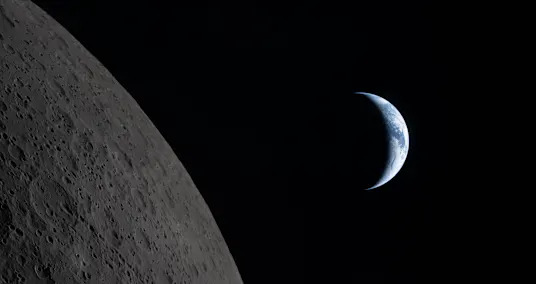
Among the stunning new images uploaded by NASA on Tuesday was a photo of “Earthset,” which was captured through the Orion capsule’s window at 6:41 p.m. ET, according to NASA.
"A muted blue Earth with bright white clouds sets behind the cratered lunar surface," the photo caption reads. "The dark portion of Earth is experiencing nighttime. On Earth’s day side, swirling clouds are visible over the Australia and Oceania region.”
Visible in the foreground is the moon, with the Ohm crater’s “terraced edges and a flat floor interrupted by central peaks,” per NASA’s description.

The crew also captured “Earthrise,” recreating the iconic photo taken during the Apollo 8 mission in 1968.

Also included in the new batch of images is a view of the solar eclipse that the crew experienced near the end of the flyby.

The astronauts donned eclipse viewers to protect their eyes during the nearly hour-long celestial event. But they still struggled to put into words what they were witnessing.

“Humans probably have not evolved to see what we're seeing," Glover told mission control. "It is truly hard to describe.”

Other photos captured close-up views of the lunar surface, including little-seen craters and basins from the vantage point of the crew, which at one point came within about 4,000 miles of the moon.
During Monday’s flyby, the Artemis II set a new record for the farthest distance from Earth traveled by humans — 252,756 miles, surpassing the previous mark set by Apollo 13 in 1970.


LATEST POSTS
- 1
 Rick Steves Doesn't Want You Overlooking This Food Spot While In France
 - 2Figure out How to Store Your Gold Ventures: A Thorough Aide safely
- 3Hitting the brakes: Hubble Space Telescope watches doomed comet reverse its spin
- 4See the metal guts of a satellite in this wild X-ray view | Space photo of the day for Dec. 4, 2025
- 5Doctors say changes to US vaccine recommendations are confusing parents and could harm kids




- EPA watchdog finds nation’s most contaminated sites are vulnerable to flooding, wildfires
- James Webb Space telescope spots 'big red dot' in the ancient universe: A ravenous supermassive black hole named 'BiRD'
- Does physics say that free will doesn't exist?
- New funding transforms lives by expanding electricity access across Africa
- Mexico says a third of 130,000 missing people might be alive, fueling criticism from families
- 6 Vehicle Rental Administrations: Pick Your Ideal Ride
- Avoid This Common Mistake When Planning Sightseeing Activities For Your Trip To Italy
- Instructions to Shield Your Gold Speculation from Possible Dangers: Fundamental Protections
- The Best Computer games for Multiplayer Fun